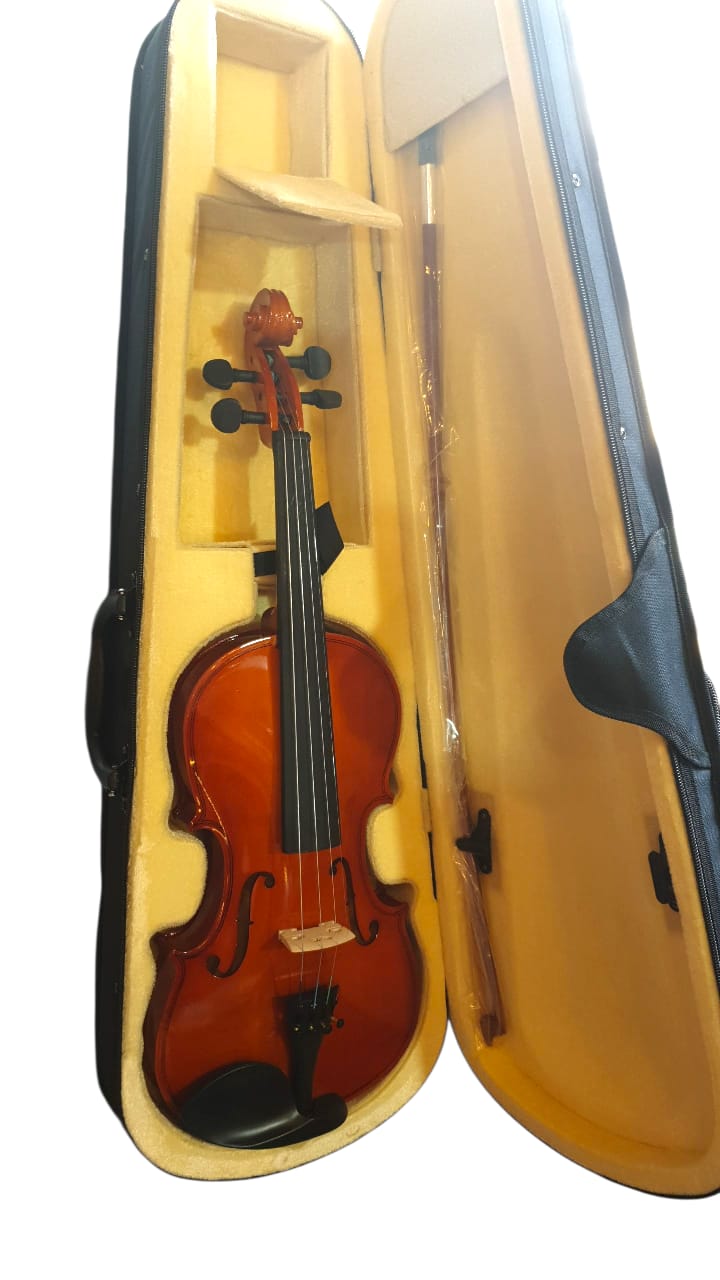
Violin Chinese Brand 4/4
Violin Chinese Brand 4/4
Regular price
350.00 AED
Regular price
299.00 AED
Sale price
350.00 AED
Couldn't load pickup availability
The violin, or fiddle, is a four-stringed wooden chordophone and the smallest, highest-pitched member of the string family. Played with a bow, it is fundamental to classical, folk, and popular music, tuned in fifths (G3, D4, A4, E5). Originating in 16th-century Italy, it is renowned for its agile, bright tone and extensive orchestral, chamber, and solo repertoire.
 Wikipedia +4
Wikipedia +4
Key Characteristics and Structure
- Structure: Composed of a hollow wooden body with an hourglass shape, four strings (sometimes five) stretched over a bridge, a fingerboard without frets, and a tailpiece with optional fine tuners.
- Strings: Traditionally tuned G-D-A-E, from lowest to highest pitch.
-
Bow:
Sound is produced by drawing a horsehair bow across the strings or by plucking (pizzicato).
Size: The standard, full-size violin is often called a 4/4, with smaller sizes (1/8, 1/4, 1/2, 3/4) available for learners.
 YouTube +4
This video explains the different parts of a violin:


Role and History
- Orchestra: Violins are divided into first and second sections, with the first violin leader serving as the orchestra's concertmaster.
- Origins: Appeared in Italy in the mid-16th century, with early makers including Andrea Amati.
-
Family: The highest-pitched member of the violin family, which includes the viola, cello, and double bass.
Playing the Violin
- Technique: The instrument is held between the left collarbone/shoulder and the jaw. Pitch is determined by pressing strings down on the fingerboard with the left hand.
-
Notation: Music is written in treble clef.
Yamaha Corporation +4
Violin vs. Viola
-
While similar in shape, the viola is larger, has a deeper, mellower tone, and is tuned a fifth lower than the violin (C3, G3, D4, A4).
- Heading
- Heading
- Heading